
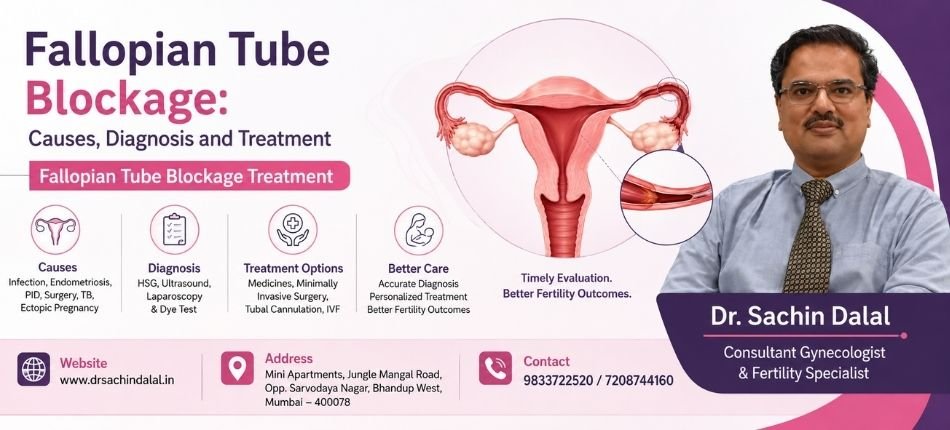
Fallopian Tube Blockage: Causes, Diagnosis and Treatment | Fallopian Tube Blockage Treatment – Dr. Sachin Dalal
Fallopian tubes play an important role in natural conception. They connect the ovaries to the uterus and provide the usual pathway where the egg and sperm meet. If one or both fallopian tubes are blocked or damaged, it may become more difficult to conceive naturally.
A blocked fallopian tube often does not cause obvious symptoms and may only be discovered during fertility evaluation. The appropriate Fallopian Tube Blockage Treatment depends on several factors, including whether one or both tubes are affected, the location and severity of the blockage, the underlying cause, the condition of the remaining tube and other fertility factors.
Understanding the causes, diagnostic methods and available treatment options can help couples make informed decisions about their fertility care.
What Is Fallopian Tube Blockage?
The fallopian tubes are two thin tubes extending from the uterus toward the ovaries. After ovulation, an egg is picked up by the fallopian tube. Fertilization usually occurs within the tube, after which the fertilized egg travels toward the uterus for implantation.
When a tube becomes blocked, scarred or damaged, the egg and sperm may not be able to meet or the fertilized egg may have difficulty reaching the uterus.
A blockage may affect one tube or both tubes. The effect on fertility therefore varies from one woman to another.
How Does Fallopian Tube Blockage Affect Fertility?
If both fallopian tubes are completely blocked, natural fertilization generally cannot occur because sperm cannot reach the egg through the normal pathway.
When only one tube is blocked and the other tube is healthy, natural pregnancy may still be possible. However, the chances depend on several additional factors, including ovulation, age, ovarian reserve, semen parameters and the health of the functioning tube.
Tubal damage can also increase the risk of an ectopic pregnancy, in which a pregnancy implants outside the uterus, most commonly in a fallopian tube.
Common Causes of Fallopian Tube Blockage
Several medical conditions can lead to inflammation, scarring or damage of the fallopian tubes.
1. Pelvic Inflammatory Disease
Pelvic inflammatory disease (PID) is an infection involving the female reproductive organs. In some cases, inflammation caused by PID can result in scarring and adhesions around or inside the fallopian tubes.
The extent of damage can vary, which is why individual fertility evaluation is important.
2. Previous Pelvic or Abdominal Surgery
Previous surgery involving the abdomen or pelvis may sometimes result in scar tissue or adhesions. These adhesions can affect the normal position or function of the fallopian tubes.
A complete medical and surgical history can therefore be important during fertility evaluation.
3. Endometriosis
Endometriosis occurs when tissue similar to the lining of the uterus grows outside the uterus. It can cause inflammation and adhesions around the ovaries and fallopian tubes.
Depending on its location and severity, endometriosis may interfere with the normal movement of the egg or affect tubal function.
4. Previous Ectopic Pregnancy
A previous ectopic pregnancy can sometimes damage the affected fallopian tube. Treatment for an ectopic pregnancy may also involve removal or surgery of the tube depending on the clinical situation.
Women with a previous ectopic pregnancy should discuss future pregnancy planning with their gynecologist.
5. Genital Tuberculosis
In regions where tuberculosis is prevalent, genital tuberculosis can be an important cause of tubal damage and infertility. It may affect the fallopian tubes and other reproductive organs and can sometimes occur without obvious symptoms.
Diagnosis requires proper medical evaluation and should not be made based on symptoms alone.
6. Hydrosalpinx
Hydrosalpinx occurs when a damaged fallopian tube becomes blocked and fills with fluid. This usually reflects significant tubal damage and can affect fertility.
Hydrosalpinx can also influence fertility-treatment decisions, including management before IVF in selected patients.
Symptoms of Blocked Fallopian Tubes
Many women with blocked fallopian tubes experience no specific symptoms. The condition is often identified only when pregnancy does not occur after a period of trying to conceive.
Depending on the underlying condition, some women may experience pelvic pain, painful periods, pain during intercourse or unusual vaginal discharge. These symptoms are not specific to tubal blockage and may be associated with several gynecological conditions.
Therefore, symptoms alone cannot confirm whether a fallopian tube is blocked.
How Is Fallopian Tube Blockage Diagnosed?
A fertility specialist may recommend tests to evaluate whether the fallopian tubes are open and functioning appropriately.
Hysterosalpingography (HSG)
HSG is an X-ray-based procedure in which contrast material is introduced through the cervix into the uterus. X-ray images are then taken to assess the uterine cavity and whether the contrast passes through the fallopian tubes.
If the contrast does not pass through a tube, a blockage may be suspected.
However, apparent blockage—particularly near the uterus—can occasionally result from temporary tubal spasm, so results need to be interpreted in clinical context.
Ultrasound-Based Tubal Assessment
In selected cases, an ultrasound-based test using fluid or contrast may be used to evaluate tubal patency.
The most appropriate investigation depends on the patient’s history and the doctor’s assessment.
Laparoscopy
Laparoscopy is a minimally invasive surgical procedure that allows a doctor to directly examine the pelvis, uterus, ovaries and fallopian tubes.
During laparoscopy, dye may be passed through the cervix to assess whether it flows through the tubes. Laparoscopy can also help identify conditions such as endometriosis and pelvic adhesions.
Because it is a surgical procedure, it is generally recommended when clinically appropriate rather than routinely for every fertility evaluation.
Fallopian Tube Blockage Treatment Options
There is no single treatment suitable for every patient. Fallopian Tube Blockage Treatment depends on the location and severity of the blockage, the extent of tubal damage, age, fertility history and other reproductive factors.
Tubal Cannulation
For certain blockages close to where the fallopian tube meets the uterus, tubal cannulation may be considered. A thin catheter or guidewire is used to try to open the obstruction.
Not every type of tubal blockage is suitable for this procedure.
Laparoscopic Surgery
If adhesions or selected types of tubal disease are affecting fertility, laparoscopic surgery may sometimes be considered.
The goal may be to remove adhesions or improve the anatomy around the tube and ovary. The expected benefit depends heavily on how much healthy tube remains.
Management of Hydrosalpinx
When hydrosalpinx is present, management depends on the extent of damage and the fertility plan.
In women proceeding with IVF, a specialist may recommend treating or removing/separating the affected tube before embryo transfer in appropriate cases because hydrosalpinx fluid can negatively affect IVF outcomes.
IVF
When both tubes are severely blocked or damaged, in vitro fertilization (IVF) may be considered. IVF bypasses the fallopian tubes by retrieving eggs from the ovaries, fertilizing them in a laboratory and transferring an embryo into the uterus.
Whether IVF is appropriate depends on the couple’s complete fertility evaluation rather than tubal status alone.
Can You Get Pregnant With One Blocked Fallopian Tube?
Yes, pregnancy may still occur naturally when one fallopian tube is blocked, provided the other tube is healthy and other fertility factors are favourable.
However, the probability of pregnancy varies considerably between individuals. A fertility evaluation can help determine whether continued natural attempts, treatment or assisted reproductive techniques should be considered.
Can Blocked Fallopian Tubes Be Opened Without Surgery?
This depends entirely on the cause and location of the blockage. Certain proximal blockages may sometimes be treated with tubal cannulation, while severely scarred or damaged tubes may not be suitable for reopening.
Medicines generally cannot reverse established scar tissue inside a damaged fallopian tube. Treatment should therefore be based on proper diagnostic testing rather than unproven methods promoted as ways to “naturally unblock” the tubes.
When Should You Consult a Gynecologist?
Consider consulting a gynecologist or fertility specialist if you have been trying to conceive without success, particularly if you have a history of pelvic infection, endometriosis, ectopic pregnancy, pelvic surgery or suspected tubal disease.
Fertility evaluation is commonly recommended after 12 months of regular unprotected intercourse for women under 35, and after 6 months for women aged 35 or older. Earlier evaluation may be appropriate when known fertility risk factors are present.
Conclusion
Fallopian tube blockage is an important possible cause of female infertility, but its impact and treatment vary considerably between patients. Some women have one healthy functioning tube and may still conceive naturally, while others may require procedures or assisted reproductive treatment.
Accurate diagnosis is therefore the first step toward choosing appropriate Fallopian Tube Blockage Treatment. Tests such as HSG and, in selected cases, ultrasound-based assessment or laparoscopy can help determine the location and extent of tubal disease.
A personalized fertility evaluation can then help determine whether expectant management, tubal treatment, surgery or IVF is the most suitable approach.
Consult Dr. Sachin Dalal
For evaluation and treatment of fertility and gynecological concerns, consult Dr. Sachin Dalal for an individualized assessment and treatment plan.
Fallopian Tube Blockage Treatment Fallopian Tube Blockage Treatment Fallopian Tube Blockage Treatment Fallopian Tube Blockage Treatment Fallopian Tube Blockage Treatment Fallopian Tube Blockage Treatment Fallopian Tube Blockage Treatment Fallopian Tube Blockage Treatment Fallopian Tube Blockage Treatment Fallopian Tube Blockage Treatment Fallopian Tube Blockage Treatment Fallopian Tube Blockage Treatment