
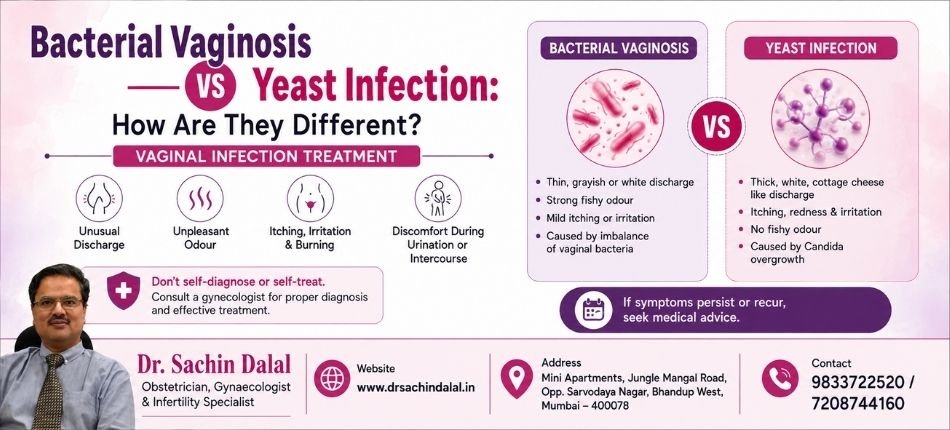
Bacterial Vaginosis vs Yeast Infection: How Are They Different? |Vaginal Infection Treatment – Dr. Sachin Dalal
Introduction
Vaginal discharge is normal and can change throughout the menstrual cycle. However, when discharge is accompanied by an unusual smell, itching, burning, irritation, or discomfort, it may indicate an infection or another vaginal health condition.
Two commonly confused conditions are bacterial vaginosis (BV) and vaginal yeast infection. Although both can cause changes in vaginal discharge and discomfort, their causes and typical symptoms are different. As a result, the appropriate treatment can also differ.
Understanding bacterial vaginosis vs yeast infection can help women recognize when symptoms require medical evaluation rather than relying on self-diagnosis or repeatedly using over-the-counter treatments.
If you are experiencing persistent or recurrent symptoms, consulting a gynecologist can help identify the underlying cause and determine appropriate Vaginal Infection Treatment.
What Is Bacterial Vaginosis?
Bacterial vaginosis is a condition associated with an imbalance in the normal bacteria present in the vagina. Normally, different types of bacteria coexist in the vaginal environment. When this balance changes and certain bacteria become more abundant, bacterial vaginosis can develop.
Some women with BV have no noticeable symptoms. When symptoms are present, changes in discharge and vaginal odour are common.
BV is not the same condition as a yeast infection, and therefore treatment used for a fungal infection will not appropriately treat bacterial vaginosis.
What Is a Vaginal Yeast Infection?
A vaginal yeast infection, also known as vulvovaginal candidiasis, is usually caused by an overgrowth of Candida, a type of yeast that can normally be present in the body.
When conditions allow the yeast to multiply excessively, symptoms such as itching, irritation, soreness, and abnormal discharge may develop.
Certain factors, including recent antibiotic use, pregnancy, poorly controlled diabetes, and other changes affecting the vaginal environment, can increase the likelihood of developing a yeast infection.
Bacterial Vaginosis vs Yeast Infection: What Is the Main Difference?
The fundamental difference is the underlying cause.
Bacterial vaginosis is associated with an imbalance of vaginal bacteria, whereas a yeast infection involves an overgrowth of yeast, most commonly Candida.
Because they have different causes, they generally require different forms of treatment. This is one reason accurate diagnosis is important when symptoms are new, persistent, severe, or recurrent.
Symptoms of Bacterial Vaginosis
Women with bacterial vaginosis may experience:
- Thin vaginal discharge
- White or greyish discharge
- A noticeable fishy vaginal odour
- Burning or irritation in some cases
- Burning during urination in some women
Some women may have BV without experiencing obvious symptoms.
Symptoms of a Yeast Infection
Typical symptoms associated with vaginal candidiasis may include:
- Significant vaginal or vulvar itching
- Irritation and soreness
- Redness or swelling
- Burning sensation
- Discomfort during urination or intercourse
- Thick vaginal discharge, which may be white
Unlike bacterial vaginosis, a strong fishy smell is not a typical feature of a yeast infection.
Vaginal Discharge: Can It Help Tell the Difference?
The appearance of vaginal discharge can provide clues, but it should not be used as the only method of diagnosis.
BV is often associated with thin, white or grey discharge, while yeast infections can cause thicker white discharge.
However, symptoms can overlap, and other infections or conditions can produce similar changes.
For this reason, diagnosing the condition based only on the colour or consistency of discharge may lead to inappropriate treatment.
What Causes Bacterial Vaginosis?
BV occurs when the natural balance of vaginal bacteria is disrupted.
Certain factors and behaviours are associated with an increased likelihood of BV, including vaginal douching and changes in sexual activity. However, BV is not simply a result of poor personal hygiene.
Women experiencing recurrent BV should discuss their symptoms and possible contributing factors with their gynecologist.
What Causes Yeast Infections?
A vaginal yeast infection usually develops when Candida, a type of yeast that can normally live in the vaginal environment without causing problems, begins to grow excessively. This overgrowth can occur when the natural balance of microorganisms in the vagina is disrupted. Factors that may increase the likelihood of a yeast infection include recent antibiotic use, pregnancy and hormonal changes, poorly controlled diabetes, and a weakened immune system. Some women may also experience recurrent yeast infections. Because itching, irritation, and abnormal discharge can occur with several vaginal conditions, women with persistent or frequently recurring symptoms should consult a gynecologist for proper diagnosis and appropriate Vaginal Infection Treatment rather than repeatedly self-treating.
Can BV and a Yeast Infection Occur Together?
It is possible for more than one vaginal condition or infection to be present at the same time. Additionally, several sexually transmitted infections and non-infectious conditions can produce symptoms similar to BV or candidiasis.
This makes self-diagnosis based on symptoms alone unreliable in some cases.
If symptoms do not improve after treatment, repeatedly return, or are different from previous episodes, medical evaluation is advisable.
How Are Vaginal Infections Diagnosed?
A gynecologist will usually begin by discussing your symptoms and medical history. Depending on the situation, a pelvic examination and testing of vaginal discharge may be recommended.
Testing can help distinguish between bacterial vaginosis, candidiasis, certain sexually transmitted infections, and other possible causes of vaginal symptoms.
An accurate diagnosis allows treatment to target the actual cause rather than simply treating the most noticeable symptom.
Bacterial Vaginosis Treatment
Bacterial vaginosis is generally treated with prescribed antibiotics. The specific medication, formulation, and duration depend on individual circumstances and clinical assessment.
Patients should take or use prescribed medicines according to their doctor’s instructions.
Women who experience repeated episodes of BV may require further evaluation and a different management approach.
Yeast Infection Treatment
Vaginal yeast infections are treated with antifungal medicines. Depending on the individual case, treatment may involve vaginal preparations or oral medication.
However, repeatedly taking antifungal medication whenever itching or discharge develops is not advisable without confirming the cause, particularly when symptoms are recurrent.
Symptoms assumed to be a yeast infection may sometimes be caused by BV, another infection, skin irritation, or another condition.
Why Self-Treatment Can Be a Problem
Because vaginal infections share several symptoms, it can be difficult to determine the cause without appropriate evaluation.
Using antifungal medication when the problem is bacterial will not treat the underlying condition. Similarly, unnecessary use of antibiotics or other medicines should be avoided.
Professional Vaginal Infection Treatment begins by identifying the cause and then choosing treatment accordingly.
When Should You Consult a Gynecologist?
Consider seeking medical advice if:
- Symptoms are occurring for the first time
- Discharge has changed significantly
- There is a strong or unusual odour
- Itching or burning is persistent
- Symptoms keep returning
- Previous treatment has not helped
- You are pregnant
- You are concerned about possible STI exposure
- You experience pelvic pain, fever, sores, or bleeding not related to your period
Some of these symptoms may require assessment for conditions other than BV or candidiasis.
Can Vaginal Infections Be Prevented?
Not every vaginal infection can be prevented, but maintaining healthy habits may reduce unnecessary irritation and disruption of the vaginal environment.
Avoid vaginal douching and unnecessary use of fragranced products inside or around sensitive areas. Follow prescribed medicines correctly, maintain appropriate diabetes management if applicable, and seek medical advice for recurrent symptoms.
Conclusion
Although bacterial vaginosis and yeast infections can produce similar symptoms, they are not the same condition. BV involves an imbalance in vaginal bacteria, while vaginal candidiasis is caused by yeast overgrowth.
Because discharge, itching, burning, and irritation can also occur with other conditions, symptoms alone may not always provide an accurate diagnosis.
If you have persistent, severe, unusual, or recurrent vaginal symptoms, consult Dr. Sachin Dalal for evaluation and appropriate Vaginal Infection Treatment based on the underlying cause.
Vaginal Infection Treatment Vaginal Infection Treatment Vaginal Infection Treatment Vaginal Infection Treatment Vaginal Infection Treatment Vaginal Infection Treatment Vaginal Infection Treatment Vaginal Infection Treatment Vaginal Infection Treatment Vaginal Infection Treatment Vaginal Infection Treatment