
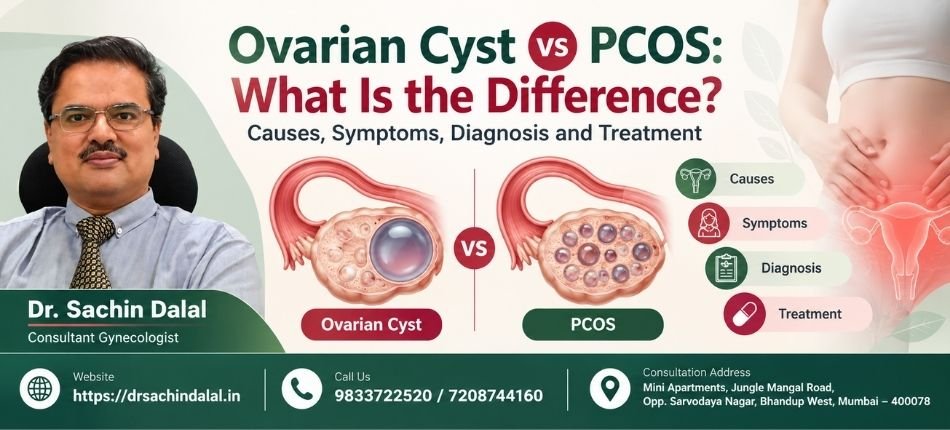
Ovarian Cyst vs PCOS: What Is the Difference? Causes, Symptoms, Diagnosis and Treatment – Dr. Sachin Dalal
Ovarian cysts and Polycystic Ovary Syndrome (PCOS) are two common gynecological conditions that affect women of reproductive age. Although both involve the ovaries, they are different conditions with distinct causes, symptoms, and treatment approaches. Understanding Ovarian Cyst vs PCOS is important because the two conditions can sometimes cause similar symptoms, including irregular periods, pelvic discomfort, and fertility concerns.
An ovarian cyst is a fluid-filled sac that develops in or on an ovary, while PCOS is a hormonal and metabolic disorder that can affect ovulation, menstrual cycles, and androgen levels. Not every ovarian cyst indicates PCOS, and women with PCOS do not necessarily have ovarian cysts.
If you are experiencing irregular menstrual cycles, persistent pelvic pain, or other reproductive health concerns, consulting an experienced gynecologist can help identify the underlying cause. At Dr. Sachin Dalal’s Gynecology Clinic, patients can seek professional guidance regarding menstrual health, ovarian conditions, and other gynecological concerns.
What Is an Ovarian Cyst?
An ovarian cyst is a sac containing fluid or other material that develops within or on the surface of an ovary. Ovarian cysts are relatively common, particularly during the reproductive years.
Many ovarian cysts are harmless, cause no noticeable symptoms, and disappear naturally within a few menstrual cycles. However, some cysts may grow larger, cause discomfort, or require medical evaluation.
Common Types of Ovarian Cysts
1. Functional Cysts
Functional cysts develop as part of the normal menstrual cycle. They are among the most common ovarian cysts and usually resolve without treatment.
Two common types include:
-
Follicular cysts: Develop when a follicle does not release an egg and continues growing.
-
Corpus luteum cysts: Form when the structure remaining after ovulation fills with fluid or blood.
2. Dermoid Cysts
Also called mature cystic teratomas, these cysts may contain different types of tissue, such as hair, skin, or fat. They are usually benign but may require monitoring or surgery depending on their size and symptoms.
3. Endometriomas
Endometriomas are ovarian cysts associated with endometriosis. They contain old blood and may cause painful periods, chronic pelvic pain, or fertility difficulties.
4. Cystadenomas
These cysts develop from cells on the ovarian surface and may contain watery or mucus-like material. Some can grow quite large and require surgical assessment.
Symptoms of Ovarian Cysts
Many ovarian cysts produce no symptoms. When symptoms occur, they may include:
-
Pain or discomfort in the lower abdomen
-
Pelvic pain, sometimes more noticeable on one side
-
Abdominal bloating or a feeling of fullness
-
Pressure in the pelvic region
-
Pain during sexual intercourse
-
Frequent urination if a large cyst presses on the bladder
-
Changes in menstrual bleeding in some cases
Sudden, severe pelvic pain, especially with vomiting, fainting, or dizziness, requires immediate medical attention because it may indicate ovarian torsion, cyst rupture with bleeding, or another emergency.
What Is PCOS (Polycystic Ovary Syndrome)?
Polycystic Ovary Syndrome, commonly known as PCOS, is a hormonal and metabolic condition that affects how the ovaries function.
Women with PCOS may experience irregular ovulation, increased androgen levels, acne, unwanted facial hair growth, and changes in menstrual cycles.
PCOS may also be associated with insulin resistance, which can increase the risk of metabolic complications such as type 2 diabetes.
Despite its name, PCOS does not necessarily involve actual ovarian cysts. The small structures sometimes visible on ultrasound are usually immature ovarian follicles rather than the larger fluid-filled cysts seen in other ovarian conditions.
Common Symptoms of PCOS
PCOS symptoms vary from person to person. Common signs include:
-
Irregular or missed menstrual periods
-
Infrequent ovulation
-
Acne or persistent oily skin
-
Excess facial or body hair growth
-
Thinning hair on the scalp
-
Difficulty becoming pregnant due to irregular ovulation
-
Weight gain or difficulty managing weight in some individuals
-
Darkened skin patches, particularly around the neck or underarms
-
Multiple small follicles visible on ovarian ultrasound in some patients
Not everyone with PCOS experiences all these symptoms. PCOS can also occur in individuals with a normal body weight.
Ovarian Cyst vs PCOS: Key Differences
Although both conditions involve the ovaries, their underlying mechanisms and effects on reproductive health are different.
| Feature | Ovarian Cyst | PCOS |
|---|---|---|
| Definition | A sac containing fluid or other material in or on the ovary | A hormonal and metabolic syndrome |
| Main cause | Varies by cyst type; may relate to ovulation or other conditions | Complex hormonal, genetic, and metabolic factors |
| Menstrual cycles | Often remain normal | Frequently irregular |
| Hormonal imbalance | Not necessarily present | Commonly involves androgen excess or ovulatory dysfunction |
| Pelvic pain | May occur, particularly with larger or complicated cysts | Not a defining symptom |
| Acne and excess facial hair | Not typical of most cysts | Common symptoms |
| Fertility | May be unaffected; depends on cyst type | Irregular ovulation may affect fertility |
| Ultrasound | May show one or more distinct cysts | May show increased numbers of small ovarian follicles |
| Treatment | Observation, medication for symptoms, or surgery when appropriate | Lifestyle measures and targeted hormonal, reproductive, or metabolic treatment |
The most important difference in Ovarian Cyst vs PCOS is that an ovarian cyst is a structural finding, while PCOS is a broader syndrome affecting hormonal and metabolic function.
What Causes Ovarian Cysts and PCOS?
Causes of Ovarian Cysts
Ovarian cysts can develop for several reasons.
Normal menstrual cycle: Functional cysts may develop when the usual process of follicle growth and ovulation changes.
Endometriosis: Endometrial-like tissue growing outside the uterus can lead to ovarian endometriomas.
Abnormal tissue growth: Certain benign ovarian growths, including dermoid cysts and cystadenomas, can form independently of the menstrual cycle.
Pregnancy-related changes: Corpus luteum cysts may develop during early pregnancy and often resolve naturally.
Pelvic infections: Severe pelvic infections can sometimes cause complex inflammatory masses involving the ovaries and fallopian tubes.
Causes and Risk Factors of PCOS
The exact cause of PCOS is not fully understood. Several factors may contribute to its development.
Insulin resistance: Many individuals with PCOS have reduced sensitivity to insulin, which may contribute to increased androgen production.
Increased androgen activity: Elevated androgen levels or their effects on the body may interfere with regular ovulation.
Genetic factors: PCOS often occurs in families, suggesting that inherited factors contribute to the condition.
Hormonal regulation: Changes in reproductive hormone signaling can affect follicle development and ovulation.
PCOS is not caused simply by eating unhealthy food or gaining weight. Although weight and lifestyle can influence symptoms, people of different body sizes can develop PCOS.
How Are Ovarian Cysts and PCOS Diagnosed?
Correct diagnosis is essential because both conditions require different approaches to treatment.
Diagnosis of Ovarian Cysts
A gynecologist may recommend the following evaluations.
Pelvic ultrasound: Ultrasound helps identify the size, location, and appearance of an ovarian cyst. It can also help distinguish a simple fluid-filled cyst from a complex ovarian mass.
Medical history and pelvic examination: Symptoms, menstrual history, age, and examination findings help determine whether further investigation is necessary.
Pregnancy test: A pregnancy test may be recommended when appropriate to exclude pregnancy-related causes of pelvic pain, including ectopic pregnancy.
Blood tests: Certain blood tests may be required depending on the patient’s age, ultrasound findings, symptoms, and risk factors.
Not every ovarian cyst requires extensive testing or surgery.
Diagnosis of PCOS
PCOS is diagnosed through a combination of medical history, symptoms, examination, and selected investigations.
In adults, diagnosis generally requires at least two of the following three features after excluding other causes:
-
Irregular or absent ovulation
-
Clinical or biochemical evidence of increased androgen activity
-
Polycystic ovarian morphology on ultrasound or, in appropriate adult patients, an elevated anti-Müllerian hormone (AMH) level
AMH is not recommended as a standalone diagnostic test for PCOS.
If an adult already has irregular menstrual cycles and evidence of androgen excess, ultrasound may not be necessary for diagnosis.
Adolescents require a different diagnostic approach. Both persistent menstrual irregularity and hyperandrogenism are generally required, and ultrasound or AMH should not be used to diagnose PCOS during adolescence.
A gynecologist may also recommend blood glucose, lipid, thyroid, prolactin, or other investigations based on the clinical findings.
Can Ovarian Cysts and PCOS Affect Fertility?
Fertility concerns are an important reason why women seek medical advice about ovarian conditions.
Ovarian Cysts and Fertility
Most simple functional ovarian cysts do not cause infertility.
However, certain conditions associated with ovarian cysts, such as endometriosis, may affect reproductive health.
Large or complex cysts sometimes require surgical treatment, and fertility-preserving options should be considered when appropriate.
The impact on fertility depends on the type of cyst, underlying condition, and treatment required.
PCOS and Fertility
PCOS is a common cause of ovulatory dysfunction, meaning that ovulation may occur irregularly or not at all.
When eggs are not released regularly, predicting fertile days and achieving pregnancy may become more difficult.
However, having PCOS does not mean pregnancy is impossible.
Many women with PCOS conceive naturally or with appropriate fertility treatment.
Treatment may include lifestyle support, ovulation-inducing medications, or additional fertility care depending on individual circumstances.
For eligible women with PCOS-related anovulatory infertility and no other infertility factors, letrozole is commonly recommended as a first-line medication for inducing ovulation under medical supervision.
Treatment Options for Ovarian Cysts
Treatment depends on the cyst’s type, size, appearance, symptoms, and the patient’s age and reproductive goals.
1. Watchful Waiting
Small, simple ovarian cysts often disappear without treatment.
A gynecologist may recommend monitoring and a repeat ultrasound when clinically appropriate.
2. Pain Management
Pain-relieving medication may be recommended for mild discomfort, depending on the patient’s medical history.
Persistent or worsening pain should not be managed with painkillers alone without appropriate evaluation.
3. Hormonal Contraceptives
Hormonal contraceptives may help reduce the formation of some new functional cysts in selected patients.
However, they do not reliably make an existing functional ovarian cyst disappear faster.
4. Surgical Treatment
Surgery may be considered if a cyst is large, persistent, symptomatic, suspicious on imaging, or associated with complications.
When appropriate, minimally invasive laparoscopic surgery may be used.
The decision depends on individual clinical findings and should be discussed with a gynecologist.
Treatment and Management of PCOS
Unlike many functional ovarian cysts, PCOS is a long-term condition that may require ongoing management.
Treatment focuses on controlling symptoms, improving menstrual health, addressing metabolic risks, and supporting fertility when desired.
1. Healthy Lifestyle and Nutrition
Balanced nutrition, regular physical activity, adequate sleep, and sustainable lifestyle habits can support metabolic and reproductive health.
For patients who have excess weight, modest weight reduction may improve some PCOS symptoms. However, healthy lifestyle measures are beneficial even without weight loss.
2. Menstrual Cycle Regulation
Hormonal treatments, including combined oral contraceptive pills or progestogen-based options, may be recommended depending on medical suitability and pregnancy plans.
Managing prolonged menstrual irregularity is important because infrequent periods can increase the risk of endometrial thickening.
3. Management of Acne and Excess Hair Growth
Treatment may include suitable hormonal medication, dermatological care, and cosmetic hair-removal methods.
Some anti-androgen medicines require reliable contraception because they can harm a developing fetus.
4. Insulin Resistance and Metabolic Health
A gynecologist may assess blood glucose, cholesterol, blood pressure, and other metabolic factors.
Metformin may be considered for selected patients, particularly when metabolic indications are present.
5. Fertility Treatment
Women with PCOS who wish to conceive may benefit from ovulation monitoring and appropriate fertility treatment.
The choice of treatment depends on age, ovulatory function, other fertility factors, and individual medical needs.
Can You Have an Ovarian Cyst and PCOS at the Same Time?
Yes. A woman with PCOS can also develop a separate ovarian cyst.
PCOS does not prevent the development of functional cysts, endometriomas, or other ovarian masses.
For example, a woman with PCOS may experience irregular menstrual cycles due to hormonal dysfunction while also developing a functional ovarian cyst.
Similarly, finding an ovarian cyst on ultrasound does not automatically mean that a woman has PCOS.
This is why ultrasound findings must be interpreted alongside symptoms, menstrual history, and appropriate hormonal investigations.
When Should You Consult a Gynecologist?
Medical consultation is recommended if you experience persistent symptoms such as:
-
Repeatedly missed or irregular periods
-
Persistent pelvic pain or abdominal bloating
-
Unexplained changes in menstrual bleeding
-
Excess facial hair growth or persistent acne
-
Difficulty conceiving
-
Unusual pressure or discomfort in the lower abdomen
-
A previously identified ovarian cyst that requires follow-up
Seek emergency medical care for sudden severe pelvic pain, fainting, marked dizziness, or pain accompanied by significant vomiting or bleeding.
Early evaluation can help distinguish between common hormonal changes, ovarian cysts, PCOS, and other gynecological conditions.
Why Consult Dr. Sachin Dalal for Ovarian and Menstrual Health Concerns?
Understanding the difference between an ovarian cyst and PCOS requires careful assessment of symptoms, menstrual patterns, medical history, and diagnostic findings.
Dr. Sachin Dalal provides gynecological consultation for women experiencing menstrual irregularities and other reproductive health concerns.
A consultation may help patients understand their symptoms, identify appropriate investigations, and discuss management options based on their individual needs.
For more information about gynecological care, explore Gynecology Treatment or learn more about consulting a Trusted Gynecologist in Bhandup.
Conclusion
Understanding Ovarian Cyst vs PCOS helps women recognize that these are two different conditions requiring individualized evaluation and treatment.
An ovarian cyst is usually a localized ovarian finding, while PCOS is a hormonal and metabolic syndrome that may affect menstrual cycles, ovulation, skin health, and fertility.
Although some symptoms overlap, the conditions cannot be reliably distinguished through symptoms alone.
If you are experiencing irregular periods, pelvic discomfort, or fertility concerns, consulting a qualified gynecologist can help determine the cause and guide appropriate treatment.
Dr. Sachin Dalal offers gynecological consultation to help women better understand their reproductive health concerns and available management options.
Ovarian Cyst vs PCOS Ovarian Cyst vs PCOS Ovarian Cyst vs PCOS Ovarian Cyst vs PCOS Ovarian Cyst vs PCOS Ovarian Cyst vs PCOS Ovarian Cyst vs PCOS Ovarian Cyst vs PCOS Ovarian Cyst vs PCOS Ovarian Cyst vs PCOS Ovarian Cyst vs PCOS Ovarian Cyst vs PCOS Ovarian Cyst vs PCOS Ovarian Cyst vs PCOS Ovarian Cyst vs PCOS Ovarian Cyst vs PCOS Ovarian Cyst vs PCOS Ovarian Cyst vs PCOS Ovarian Cyst vs PCOS