
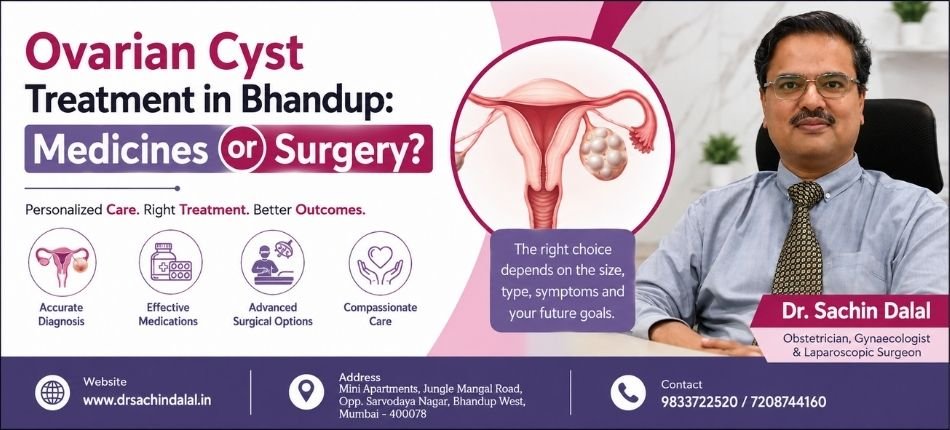
Ovarian Cyst Treatment in Bhandup: Medicines or Surgery? | Dr. Sachin Dalal
Ovarian cysts are fluid-filled sacs that develop in or on the ovaries. They are common, particularly during the reproductive years, and many ovarian cysts are harmless and disappear naturally. However, some cysts may grow larger, cause pain or other symptoms, or require further evaluation and treatment.
If you have been diagnosed with an ovarian cyst, one of the first questions you may have is whether it can be treated with medicines or whether surgery will be necessary. The right approach depends on several factors, including the type and size of the cyst, your age, symptoms, ultrasound findings, and overall health.
For women looking for Ovarian Cyst Treatment in Bhandup, consulting an experienced gynecologist can help determine whether monitoring, medication, or surgical management is appropriate.
What Is an Ovarian Cyst?
An ovarian cyst is a sac containing fluid or other material that develops within or on the surface of an ovary. Many cysts develop as part of the normal menstrual cycle and may resolve without treatment.
Other ovarian cysts can occur due to conditions such as endometriosis or abnormal tissue growth. Because ovarian cysts are not all the same, proper evaluation is important before deciding on treatment.
What Are the Common Types of Ovarian Cysts?
Functional Cysts
Functional cysts develop as part of the menstrual cycle and are among the most common ovarian cysts. They include follicular cysts and corpus luteum cysts. Many resolve naturally over time.
Endometriomas
Endometriomas are associated with endometriosis. They form when tissue similar to the lining of the uterus grows on or within an ovary.
Dermoid Cysts
Dermoid cysts, also called mature cystic teratomas, develop from germ cells and may contain different types of tissue. Depending on their size and other factors, surgical removal may sometimes be recommended.
Cystadenomas
These cysts develop from cells on the surface of the ovary. Some can become quite large and may require medical or surgical management.
What Are the Symptoms of an Ovarian Cyst?
Many ovarian cysts do not cause any noticeable symptoms and may only be discovered during a routine pelvic examination or ultrasound. However, when a cyst becomes larger or causes pressure on surrounding structures, a woman may experience pelvic or lower abdominal pain, abdominal bloating, a feeling of heaviness or fullness, pain during intercourse, changes in menstrual patterns, or frequent urination. In some cases, symptoms may become more noticeable during physical activity or around menstruation. Sudden and severe pelvic pain, especially when accompanied by nausea, vomiting, dizziness, fainting, or unusual bleeding, requires prompt medical evaluation because it may indicate a complication such as cyst rupture or ovarian torsion.
How Are Ovarian Cysts Diagnosed?
Before recommending Ovarian Cyst Treatment in Bhandup, your gynecologist will usually evaluate your symptoms, medical history, age, menstrual history, and examination findings.
A pelvic ultrasound is commonly used to assess the cyst. It can provide information about its size, location, and appearance and whether it appears mainly fluid-filled, solid, or complex.
Depending on individual circumstances, additional tests may sometimes be recommended.
Can Ovarian Cysts Be Treated With Medicines?
Medication may be part of the management plan in selected cases, but medicines do not necessarily make every existing ovarian cyst disappear.
Pain-relieving medicines may be recommended to manage discomfort when appropriate. Hormonal medicines, such as certain contraceptive pills, may sometimes be considered to reduce the likelihood of developing some new functional cysts, depending on the patient’s circumstances.
The decision to use medication should always be based on medical evaluation rather than self-treatment.
When Is Monitoring Enough?
If a cyst appears to be a simple functional cyst, is relatively small, and is not causing significant symptoms, a doctor may recommend watchful waiting.
This means monitoring the cyst rather than immediately treating it with surgery. A follow-up ultrasound may be advised after a specific period to check whether the cyst has reduced in size, disappeared, remained unchanged, or grown.
Monitoring can prevent unnecessary intervention when a cyst is likely to resolve naturally.
When Is Surgery Recommended for an Ovarian Cyst?
Surgery may be considered when an ovarian cyst:
- Is large or continues to increase in size
- Persists over time
- Causes significant or persistent pain
- Has concerning or complex features on imaging
- Causes complications
- Requires further evaluation based on age or clinical findings
- Is suspected to be a type unlikely to disappear naturally
The decision is individualized. Having an ovarian cyst does not automatically mean that surgery is necessary.
Laparoscopic Surgery for Ovarian Cysts
When surgery is required, laparoscopic surgery may be suitable for certain ovarian cysts.
Laparoscopy is a minimally invasive surgical technique in which small incisions are made in the abdomen and a camera and specialized instruments are used to perform the procedure.
Depending on the cyst and the patient’s circumstances, the surgeon may perform an ovarian cystectomy, which involves removing the cyst while attempting to preserve healthy ovarian tissue whenever medically appropriate.
Medicines vs Surgery: How Is the Decision Made?
The choice between medicines, monitoring, and surgery for an ovarian cyst depends on several factors rather than the cyst’s size alone. A gynecologist will usually consider the patient’s age, symptoms, type and size of the cyst, ultrasound appearance, whether the cyst is growing or persistent, menopausal status, medical history, and future fertility plans. Small, simple functional cysts may only require regular monitoring, while medicines may be prescribed to manage pain or certain associated hormonal conditions. Surgery may be considered when a cyst is large, persistent, causing significant symptoms, increasing in size, has complex or concerning features, or is associated with complications. Therefore, the most appropriate Ovarian Cyst Treatment in Bhandup should be determined after a complete gynecological evaluation rather than through self-medication or assuming that every ovarian cyst requires surgery.
Can Ovarian Cysts Affect Fertility?
Many ovarian cysts do not affect fertility. Functional cysts, for example, are common during the reproductive years and often resolve naturally.
However, certain conditions associated with ovarian cysts, such as endometriosis, may be linked with fertility difficulties in some women.
If future pregnancy is important to you, discuss your fertility goals with your gynecologist before undergoing treatment.
What Happens If an Ovarian Cyst Is Left Untreated?
The outcome depends on the type of cyst. Many small functional cysts disappear naturally and require only observation.
Other cysts may persist or increase in size. In some situations, complications such as rupture or ovarian torsion can occur.
This is why regular medical follow-up is important when an ovarian cyst has been identified.
When Should You Seek Urgent Medical Care?
Seek prompt medical attention if you develop sudden or severe pelvic or abdominal pain, particularly when accompanied by symptoms such as vomiting, dizziness, fainting, weakness, or significant bleeding.
These symptoms can have several causes and require medical assessment.
Why Consult Dr. Sachin Dalal for Ovarian Cyst Treatment in Bhandup?
Choosing the right treatment begins with an accurate diagnosis. Dr. Sachin Dalal provides gynecological evaluation and treatment based on the patient’s symptoms, diagnostic findings, age, reproductive plans, and individual medical requirements.
For women seeking Ovarian Cyst Treatment in Bhandup, timely consultation can help determine whether observation, medical management, or surgery is appropriate rather than assuming that every cyst needs an operation.
Conclusion
Being diagnosed with an ovarian cyst does not necessarily mean you need surgery. Many cysts can simply be monitored, while some patients may require medication for symptom management or related conditions. Surgery may be recommended for cysts that are persistent, large, symptomatic, complex, or otherwise medically concerning.
If you are experiencing pelvic pain, bloating, menstrual changes, or have recently been diagnosed with an ovarian cyst, consult a gynecologist for proper evaluation.
For appropriate Ovarian Cyst Treatment in Bhandup, Dr. Sachin Dalal can assess your condition and recommend a treatment approach based on your individual needs.
Ovarian Cyst Treatment in Bhandup Ovarian Cyst Treatment in Bhandup Ovarian Cyst Treatment in Bhandup Ovarian Cyst Treatment in Bhandup Ovarian Cyst Treatment in Bhandup Ovarian Cyst Treatment in Bhandup Ovarian Cyst Treatment in Bhandup Ovarian Cyst Treatment in Bhandup Ovarian Cyst Treatment in Bhandup