
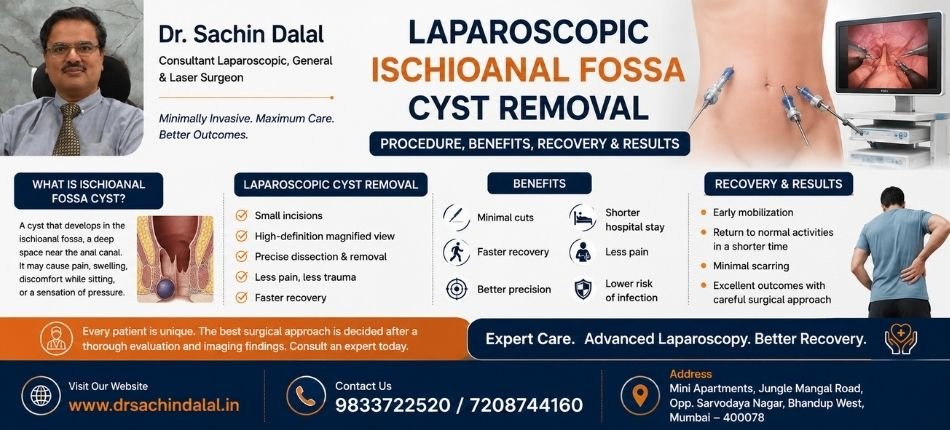
Laparoscopic Ischioanal Fossa Cyst Removal : Procedure, Benefits, Recovery & Results – Dr. Sachin Dalal
Introduction
An ischioanal fossa cyst is an uncommon cystic lesion that develops in the deep soft-tissue space adjacent to the anal canal. Because of its location, diagnosis and treatment can sometimes be challenging. Some cysts may remain unnoticed for a considerable period, while others can cause pain, pressure, swelling, discomfort while sitting, or other symptoms.
When surgical removal is recommended, the operative approach depends on the cyst’s location, size, relationship with nearby structures, imaging findings, and suspected pathology. In selected cases, a minimally invasive approach may be considered.
Laparoscopic Ischioanal Fossa Cyst Removal aims to provide surgical access through small abdominal incisions, potentially allowing good visualization of deeper pelvic structures while avoiding a larger open incision. However, not every ischioanal fossa cyst is suitable for laparoscopic removal, and treatment must be individualized.
This article explains the procedure, possible benefits, recovery process, risks, and expected outcomes.
What Is an Ischioanal Fossa Cyst?
The ischioanal or ischiorectal fossa is a fat-containing space located on either side of the anal canal. Various cystic or other lesions can occasionally develop within this region.
Because the space is relatively deep, a cyst may not always be obvious during its early stages. Symptoms depend on its size, location, underlying cause, and whether inflammation or infection is present.
Importantly, not every lump or cyst-like lesion in this region represents the same condition. Accurate diagnosis is therefore essential before treatment is planned.
What Are the Symptoms of an Ischioanal Fossa Cyst?
The symptoms of an ischioanal fossa cyst can vary depending on its size, exact location, and whether infection or inflammation is present. Some cysts may cause few or no symptoms initially, while larger lesions may lead to persistent pain or discomfort around the buttock or perianal area, a feeling of pressure or fullness, swelling, a noticeable lump, or discomfort while sitting and moving. If the cyst becomes infected, symptoms such as increasing pain, redness, tenderness, swelling, or fever may occur. Because these symptoms can resemble other anorectal or pelvic conditions, a proper clinical examination and appropriate imaging are important for an accurate diagnosis.
How Is an Ischioanal Fossa Cyst Diagnosed?
Diagnosis generally begins with a detailed medical history and clinical examination.
Because the lesion can be situated deep within the pelvis or perianal tissues, imaging is often important for understanding its location and characteristics. Depending on the clinical situation, MRI, CT, ultrasound, or other investigations may be considered.
Imaging can help determine the size and extent of the lesion and its relationship with surrounding structures. The final diagnosis may sometimes depend on histopathological examination of the surgically removed tissue.
When Is Surgery Recommended?
Surgery may be considered when the cyst causes significant symptoms, increases in size, repeatedly becomes infected, has uncertain characteristics, or when removal is considered necessary based on clinical and imaging findings.
The decision should be individualized.
Some lesions may require observation or another treatment approach, while others may be better managed surgically. The surgeon evaluates the benefits and risks before recommending the most appropriate option.
What Is Laparoscopic Ischioanal Fossa Cyst Removal?
Laparoscopic Ischioanal Fossa Cyst Removal is a minimally invasive surgical approach that may be considered for selected deep pelvic or ischioanal lesions.
During laparoscopic surgery, small incisions are created through which a camera and specialized surgical instruments are introduced. The camera provides a magnified view, helping the surgeon carefully identify anatomical structures and approach the cyst.
The exact surgical technique varies depending on the cyst’s position and surrounding anatomy.
What Happens During the Procedure?
The procedure is generally performed under anesthesia.
After laparoscopic access is established, the surgeon carefully approaches the area containing the cyst. The lesion is separated from surrounding tissues while taking care to protect important nearby structures.
The aim is usually to remove the cyst appropriately while minimizing unnecessary tissue injury.
Once removed, the specimen may be sent for histopathological examination to determine its exact nature.
The operative time and technical complexity depend on the size, location, adhesions, and relationship of the lesion to surrounding structures.
Potential Benefits of a Laparoscopic Approach
When laparoscopic surgery is clinically appropriate, it may offer several potential advantages compared with a larger open abdominal approach.
These may include:
Smaller Incisions: Laparoscopic surgery typically requires several small incisions rather than one large abdominal incision.
Enhanced Visualization: The laparoscopic camera provides magnified visualization that can help the surgeon navigate deeper anatomical spaces.
Potentially Less Postoperative Discomfort: Smaller incisions may result in less wound-related discomfort for some patients.
Potentially Faster Recovery: Some patients undergoing minimally invasive surgery may return to normal daily activities sooner than after larger open procedures.
Shorter Hospital Stay in Suitable Cases: Depending on the procedure and patient’s condition, hospitalization may sometimes be shorter.
These are potential advantages rather than guarantees, and individual outcomes vary.
Is Laparoscopic Surgery Suitable for Every Patient?
No.
The appropriate surgical approach depends on the exact location and size of the cyst, suspected diagnosis, previous surgeries, nearby structures, symptoms, and overall health of the patient.
Some lesions may be better approached through a perineal, posterior, open, or other surgical route.
A detailed evaluation and appropriate imaging are therefore essential before deciding whether laparoscopic surgery is suitable.
What Are the Possible Risks?
All surgical procedures involve potential risks.
Depending on the individual case, risks may include bleeding, infection, injury to nearby structures, anesthesia-related complications, postoperative pain, wound problems, or recurrence.
The specific risks depend heavily on the lesion’s anatomy and the surgical approach used.
Patients should discuss their individual risk profile with their surgeon before undergoing surgery.
Recovery After Laparoscopic Ischioanal Fossa Cyst Removal
Recovery varies between patients.
Immediately after surgery, the medical team monitors vital signs, pain levels, wound condition, and recovery from anesthesia. Pain medication and other supportive treatment may be prescribed as needed.
Patients are generally encouraged to follow the surgeon’s instructions regarding walking, diet, wound care, bathing, lifting, exercise, and return to work.
Follow-up appointments are important to monitor healing and discuss the histopathology report when applicable.
How Long Does Recovery Take?
There is no single recovery timeline that applies to every patient.
Recovery depends on the complexity of the surgery, size and location of the cyst, patient’s overall health, and whether any complications occur.
Some patients may resume light daily activities relatively soon, while strenuous exercise and heavy lifting may need to be restricted for longer.
The surgeon should provide personalized instructions based on operative findings and postoperative progress.
What Results Can Patients Expect?
The goal of surgery is to appropriately remove the cyst while preserving surrounding structures as much as possible.
Outcomes depend on several factors, including the type of cyst, whether complete excision is technically possible and appropriate, its relationship with nearby structures, and histopathological findings.
Patients should therefore discuss expected outcomes and the possibility of recurrence with their surgeon based on their specific diagnosis.
When Should You Contact Your Surgeon After Surgery?
Patients should follow the discharge instructions provided by their surgical team.
Prompt medical advice may be necessary if there is worsening pain, significant bleeding, persistent vomiting, increasing swelling or redness around the wound, fever, or any other concerning postoperative symptom.
Consult Dr. Sachin Dalal
Patients diagnosed with a deep pelvic or ischioanal fossa cyst require careful assessment before choosing a surgical approach.
Dr. Sachin Dalal can evaluate the patient’s symptoms, imaging findings, medical history, and individual surgical requirements to determine an appropriate treatment plan.
Conclusion
Laparoscopic Ischioanal Fossa Cyst Removal can be a minimally invasive surgical option for selected patients with appropriately located cysts. Potential advantages may include smaller incisions, enhanced visualization, and potentially quicker postoperative recovery compared with larger open abdominal approaches.
However, every cyst is different. Accurate imaging, appropriate diagnosis, careful surgical planning, and histopathological evaluation are important components of management.
Consult a qualified surgeon to determine which treatment approach is most appropriate for your individual condition.
Laparoscopic Ischioanal Fossa Cyst Removal Laparoscopic Ischioanal Fossa Cyst Removal Laparoscopic Ischioanal Fossa Cyst Removal Laparoscopic Ischioanal Fossa Cyst Removal Laparoscopic Ischioanal Fossa Cyst Removal Laparoscopic Ischioanal Fossa Cyst Removal Laparoscopic Ischioanal Fossa Cyst Removal Laparoscopic Ischioanal Fossa Cyst Removal