
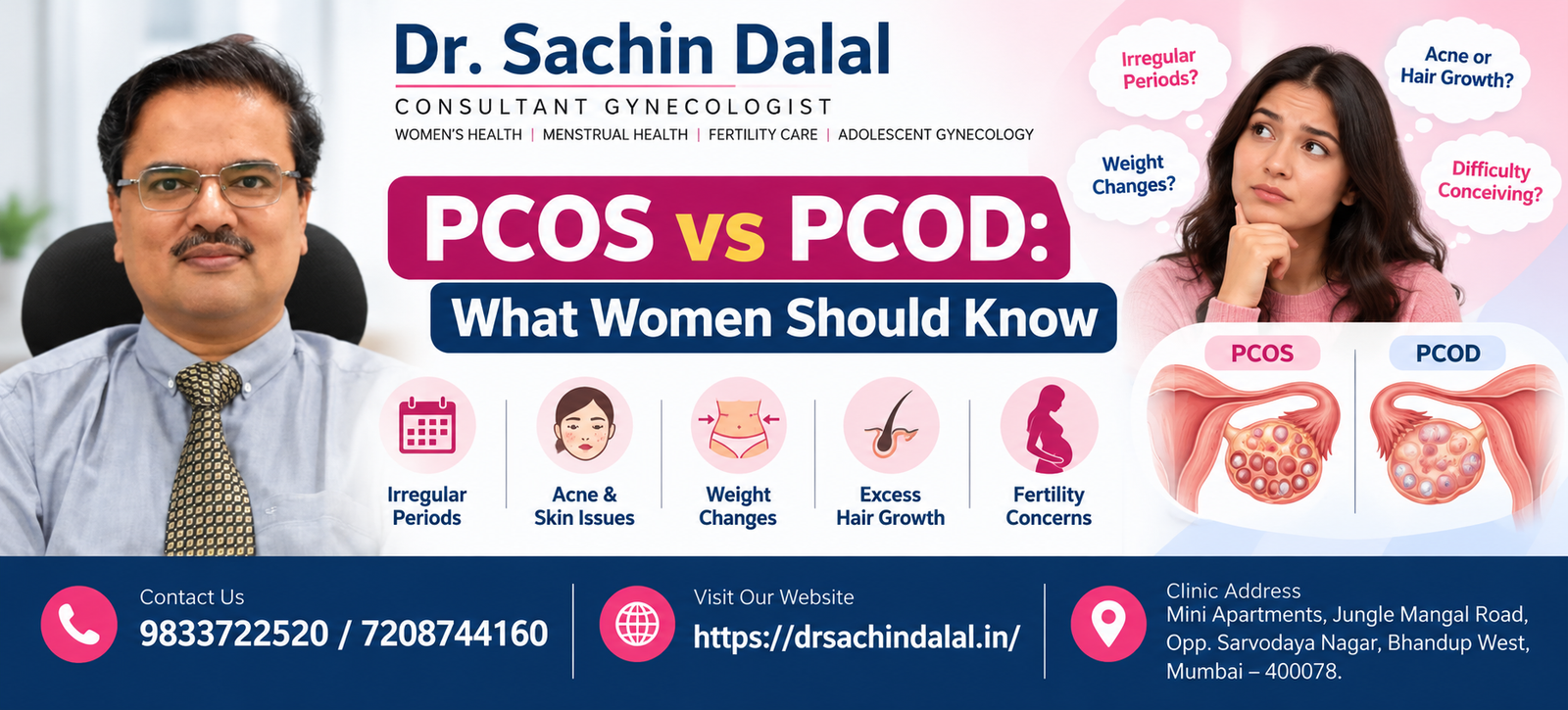
PCOS vs PCOD: What Women Should Know – Dr. Sachin Dalal
Irregular periods, unexplained acne, excessive facial hair, weight changes, and difficulty conceiving are common concerns among women experiencing hormonal imbalances. Two terms frequently mentioned during discussions about women’s reproductive health are PCOS and PCOD.
Understanding PCOS vs PCOD is important because these terms are often used interchangeably, leading to confusion about symptoms, diagnosis, fertility, and treatment.
PCOS stands for Polycystic Ovary Syndrome, while PCOD stands for Polycystic Ovarian Disease. In India, PCOD is commonly used to describe polycystic ovarian changes or symptoms associated with PCOS. However, PCOD is not a separate, universally standardized diagnosis with its own established medical criteria.
Women experiencing irregular menstrual cycles or other hormonal concerns can consult Dr. Sachin Dalal, a gynecologist in Bhandup West, Mumbai, for an appropriate medical evaluation and individualized guidance.
This article explains PCOS and PCOD, their symptoms, possible causes, effects on fertility, diagnosis, treatment options, and the importance of timely gynecological consultation.
1. What Is PCOS (Polycystic Ovary Syndrome)?
Polycystic Ovary Syndrome (PCOS) is a hormonal and metabolic condition that can affect menstrual cycles, ovulation, reproductive health, and overall well-being.
Women with PCOS may experience irregular ovulation, increased androgen levels, and characteristic changes in ovarian follicles.
Common symptoms include irregular periods, acne, excessive facial or body hair, and difficulty becoming pregnant.
PCOS may also be associated with insulin resistance, which can increase the risk of type 2 diabetes and other metabolic problems.
The condition can affect women with different body types, including those who are not overweight.
According to the World Health Organization, PCOS affects approximately 10–13% of women of reproductive age worldwide.
2. What Is PCOD (Polycystic Ovarian Disease)?
PCOD is a term frequently used in India to describe polycystic ovarian changes and related menstrual or hormonal symptoms.
The term is sometimes used when an ultrasound shows multiple small follicles in the ovaries.
However, polycystic ovarian appearance on ultrasound does not automatically mean that a woman has PCOS.
Some women may have polycystic-appearing ovaries without significant hormonal symptoms or menstrual irregularities.
PCOD is not defined as a separate disease with internationally accepted diagnostic criteria equivalent to those established for PCOS.
Therefore, rather than assuming that PCOD is a mild condition and PCOS is a severe one, it is more accurate to evaluate the woman’s symptoms, hormone levels, menstrual history, and metabolic health.
3. PCOS vs PCOD: What Is the Main Difference?
The most important difference lies in how the terms are used medically.
PCOS is an established hormonal syndrome diagnosed using recognized clinical criteria. PCOD is a commonly used term that does not have a separate, universally accepted diagnostic framework.
| Factor | PCOS | PCOD |
|---|---|---|
| Full Form | Polycystic Ovary Syndrome | Polycystic Ovarian Disease |
| Medical Status | Recognized clinical syndrome | Commonly used term, especially in India |
| Main Concerns | Ovulation, androgen levels, metabolic health | Often refers to ovarian changes or overlapping symptoms |
| Diagnosis | Established clinical criteria | No separate standardized diagnostic criteria |
| Menstrual Changes | May be irregular or absent | Depends on the underlying condition |
| Fertility | May affect ovulation and conception | Depends on whether ovulation is affected |
| Treatment | Based on symptoms and individual health risks | Based on the actual diagnosis and symptoms |
| Long-Term Monitoring | May include metabolic and reproductive health | Depends on clinical findings |
It is important to avoid treating PCOS and PCOD as automatically separate conditions with predictable differences in severity.
4. Common Symptoms of PCOS and PCOD
Symptoms vary significantly from one woman to another. Some women experience several noticeable changes, while others have relatively mild symptoms.
4.1 Irregular Menstrual Periods
Irregular or infrequent periods are among the most common symptoms of PCOS.
Hormonal changes can interfere with ovulation, resulting in unpredictable menstrual cycles.
Some women may experience long gaps between periods, while others develop prolonged or heavy bleeding.
4.2 Excessive Facial and Body Hair
Higher androgen levels may cause increased hair growth on the face, chin, chest, or abdomen.
This condition is known as hirsutism and can affect confidence and emotional well-being.
4.3 Acne and Oily Skin
Hormonal changes may increase oil production in the skin, contributing to acne.
Some women experience persistent acne around the jawline, chin, or lower face.
4.4 Hair Thinning
PCOS can sometimes cause thinning of scalp hair, particularly around the crown or parting.
This may be related to androgen activity, although nutritional deficiencies and thyroid disorders can also contribute to hair loss.
4.5 Weight Changes
Some women with PCOS experience weight gain or difficulty managing weight.
However, PCOS can also occur in women with a normal body mass index.
Weight alone cannot confirm or exclude the diagnosis.
4.6 Difficulty Conceiving
Irregular ovulation can make it more difficult to predict fertile days and achieve pregnancy.
Nevertheless, many women with PCOS conceive naturally or with appropriate fertility treatment.
5. What Causes PCOS?
The exact cause of PCOS is not fully understood.
Research suggests that genetic, hormonal, and metabolic factors contribute to its development.
Hormonal Imbalance
Increased androgen activity can interfere with normal ovarian function and contribute to acne, excessive hair growth, and irregular ovulation.
Insulin Resistance
Insulin helps regulate blood sugar levels.
In some women with PCOS, the body’s cells become less responsive to insulin, leading to increased insulin production.
Higher insulin levels can contribute to increased androgen production and metabolic complications.
Family History
Women with close relatives who have PCOS may have a greater likelihood of developing the condition.
Metabolic Factors
Body composition, insulin sensitivity, and other metabolic factors can influence PCOS symptoms.
However, PCOS is not caused simply by eating unhealthy food or failing to exercise.
6. How Does PCOS Affect the Menstrual Cycle?
A regular menstrual cycle depends on coordinated hormonal changes that support follicle development, ovulation, and shedding of the uterine lining.
In PCOS, ovulation may occur irregularly or not occur during some cycles.
This can result in:
- Delayed menstrual periods
- Missed periods
- Unpredictable menstrual cycles
- Prolonged menstrual bleeding
- Difficulty identifying ovulation
When periods remain absent for extended periods, the uterine lining may become excessively thick in some women.
Medical treatment may be needed to regulate bleeding and protect endometrial health.
Women experiencing repeated menstrual irregularities should seek gynecological evaluation rather than assuming the symptoms are normal.
7. PCOS vs PCOD: Can They Affect Fertility?
Fertility concerns are among the most common reasons women seek medical advice about PCOS.
PCOS can affect fertility primarily because ovulation may become irregular.
When an egg is not released regularly, the chances of conception during a particular cycle may be reduced.
However, a PCOS diagnosis does not mean that pregnancy is impossible.
Many women conceive naturally, while others benefit from treatment that supports ovulation.
Fertility management may include lifestyle support, assessment of other fertility factors, ovulation-inducing medication, or assisted reproductive techniques when appropriate.
The treatment approach depends on age, menstrual history, duration of infertility, and other medical factors.
8. How Are PCOS and Related Ovarian Changes Diagnosed?
There is no single test that diagnoses every case of PCOS.
A gynecologist considers symptoms, menstrual history, examination findings, and selected investigations.
In adults, PCOS is generally diagnosed when at least two of the following features are present, after other causes are excluded:
- Irregular ovulation or menstrual cycles.
- Clinical or biochemical evidence of increased androgen activity.
- Polycystic ovarian morphology identified through appropriate testing.
The 2023 international guideline also permits anti-Müllerian hormone (AMH) testing as an alternative to ultrasound for assessing polycystic ovarian morphology in adults, under specific conditions.
Ultrasound is not always necessary to diagnose PCOS. For example, adults with both irregular cycles and evidence of androgen excess may meet diagnostic criteria without ultrasound.
Diagnosis in adolescents follows different rules to avoid misinterpreting normal pubertal changes.
9. Tests a Gynecologist May Recommend for PCOS
Depending on symptoms and clinical findings, a gynecologist may recommend the following investigations.
Hormonal Blood Tests: Testosterone and selected other hormone tests may help assess androgen excess and exclude related conditions.
Thyroid Function Tests: Thyroid disorders can cause menstrual irregularities and may need to be ruled out.
Prolactin Testing: Elevated prolactin can affect menstrual cycles and ovulation.
Blood Sugar Assessment: An oral glucose tolerance test or other appropriate testing may be recommended to evaluate glucose metabolism.
Lipid Profile: Cholesterol and triglyceride testing can help assess cardiovascular and metabolic risk.
Pelvic Ultrasound: May be used to examine the ovaries and uterus when clinically appropriate.
Not every patient requires every test. Investigations should be selected according to age, symptoms, medical history, and diagnostic needs.
10. Treatment Options for PCOS and PCOD
Treatment depends on the woman’s symptoms, health risks, menstrual pattern, and pregnancy plans.
There is no single treatment suitable for everyone.
10.1 Menstrual Cycle Management
Hormonal medicines, including combined oral contraceptive pills or appropriate progestogen regimens, may be prescribed to manage irregular menstrual bleeding and protect the uterine lining.
The choice depends on individual medical suitability.
10.2 Treatment for Acne and Excess Hair
Certain hormonal treatments can help manage acne and excessive facial or body hair.
Dermatological treatments and cosmetic hair-removal methods may also be useful.
Anti-androgen medicines require careful medical supervision, particularly because some can harm a developing fetus.
10.3 Metabolic Health Management
Women with PCOS may require monitoring for blood sugar abnormalities, cholesterol changes, and blood pressure.
Metformin may be considered in selected patients, especially for metabolic indications.
10.4 Fertility Treatment
Women with PCOS who experience difficulty conceiving may benefit from fertility evaluation and ovulation-inducing treatment.
Letrozole is commonly recommended as a first-line medicine for ovulation induction in appropriately selected women with anovulatory PCOS-related infertility, under medical supervision.
10.5 Individualized Follow-Up
Long-term management may involve periodic evaluation of menstrual health, metabolic risk factors, and emotional well-being.
Treatment should be adjusted according to changing symptoms and life circumstances.
11. Diet and Lifestyle Tips for Managing PCOS
Healthy lifestyle habits play an important role in managing PCOS symptoms and supporting long-term health. A balanced diet that includes vegetables, fruits, whole grains, protein-rich foods, and healthy fats can support overall nutrition and metabolic well-being. Regular physical activity, including walking, cycling, swimming, or strength training, may improve insulin sensitivity and cardiovascular health. Adequate sleep and stress management can also support general well-being. There is no single diet that works best for every woman with PCOS, so sustainable and individualized changes are generally more helpful than restrictive eating plans.
12. Can PCOS Be Managed Without Medication?
Some women with mild symptoms may benefit from lifestyle measures and regular medical monitoring without requiring immediate medication. Healthy eating, physical activity, sleep, and appropriate weight management can improve certain metabolic and reproductive outcomes. However, lifestyle changes alone may not adequately manage prolonged menstrual absence, significant androgen-related symptoms, or infertility. Women who experience infrequent periods may require treatment to protect the uterine lining. A gynecologist can help determine whether medication, monitoring, or a combination of approaches is appropriate.
13. Does PCOS Always Cause Weight Gain?
No. PCOS does not always cause weight gain, and women with a normal body weight can also have the condition.
Some women with PCOS experience insulin resistance or other metabolic changes that make weight management more challenging.
However, body weight is only one aspect of PCOS management.
Even without weight loss, healthy eating, regular exercise, and improved sleep habits can provide meaningful health benefits.
Women should avoid assuming that losing weight is the only treatment needed for PCOS.
14. Long-Term Health Risks Associated with PCOS
Polycystic Ovary Syndrome (PCOS) can affect a woman’s overall health beyond menstrual irregularities and fertility concerns. Women with PCOS may have an increased risk of insulin resistance, type 2 diabetes, high cholesterol, and high blood pressure. Irregular ovulation and prolonged absence of periods can also increase the risk of endometrial hyperplasia and, in some cases, endometrial cancer. Additionally, PCOS may be associated with sleep apnea, anxiety, depression, and other metabolic health concerns. Regular gynecological checkups, a balanced diet, physical activity, and appropriate medical management can help reduce long-term health risks and support overall well-being.
15. PCOS and Emotional Well-Being
PCOS can affect emotional health as well as physical health.
Symptoms such as acne, unwanted facial hair, hair thinning, menstrual irregularities, and fertility concerns may contribute to stress, anxiety, or reduced self-confidence.
Some women may also experience depression or concerns about body image.
These experiences deserve appropriate attention during medical care.
Supportive communication, realistic treatment expectations, and access to mental health support when needed can help improve quality of life.
16. Common Myths About PCOS vs PCOD
Myth 1: PCOD Is Always Mild, While PCOS Is Always Severe
Fact: PCOD is not a separate standardized diagnosis with a universally accepted severity classification. The actual symptoms and health risks must be assessed individually.
Myth 2: Every Woman with PCOS Has Ovarian Cysts
Fact: PCOS can be diagnosed without polycystic ovarian morphology when other diagnostic criteria are met. The small structures seen on ultrasound are typically follicles, not necessarily true ovarian cysts.
Myth 3: Women with PCOS Cannot Become Pregnant
Fact: Many women with PCOS conceive naturally or with appropriate fertility treatment.
Myth 4: PCOS Only Affects Overweight Women
Fact: PCOS can occur across different body sizes.
Myth 5: Irregular Periods Always Mean PCOS
Fact: Thyroid disorders, pregnancy, stress, certain medications, and other medical conditions can also cause menstrual irregularities.
Myth 6: PCOS Can Be Permanently Cured with a Special Diet
Fact: PCOS is a long-term condition. Lifestyle measures and medical treatment can help manage symptoms and health risks, but no particular diet has been proven to permanently cure it.
17. When Should You Consult a Gynecologist for PCOS or PCOD?
Women should consider consulting a gynecologist when they experience persistent menstrual irregularities, excessive facial hair, unexplained acne, or difficulty conceiving. Missing periods for several months, unusually heavy menstrual bleeding, or significant changes in menstrual patterns should also be evaluated. A medical consultation helps identify whether symptoms are related to PCOS, thyroid disorders, pregnancy, or another underlying condition. Early assessment can support appropriate symptom management and monitoring of long-term health risks. Severe pelvic pain, fainting, or very heavy bleeding requires urgent medical attention.
18. PCOS and PCOD Consultation in Bhandup West – Dr. Sachin Dalal
Women experiencing irregular periods, hormonal concerns, or fertility-related difficulties can seek gynecological consultation to better understand their reproductive health.
Dr. Sachin Dalal provides gynecological consultation in Bhandup West, Mumbai.
During an appointment, patients can discuss their menstrual history, symptoms, previous investigations, and concerns about fertility or hormonal health.
An individualized assessment can help determine whether further testing or treatment is appropriate.
Patients can also explore information about gynecology treatment and available women’s health services.
Conclusion
Understanding PCOS vs PCOD can help women make informed decisions about their menstrual and reproductive health.
Although both terms are commonly used, PCOS is the medically recognized syndrome, while PCOD is a less standardized term often used for overlapping ovarian and hormonal concerns.
Symptoms such as irregular periods, acne, excessive facial hair, and fertility difficulties should not be ignored.
With appropriate diagnosis, individualized treatment, lifestyle support, and regular monitoring, many women with PCOS can effectively manage their symptoms and improve their quality of life.
If you are experiencing menstrual irregularities or other hormonal concerns, consulting a qualified gynecologist can help identify the underlying cause and suitable treatment options.
Consult Dr. Sachin Dalal for Women’s Health Concerns in Bhandup West
Dr. Sachin Dalal – Gynecological Consultation
Website: https://drsachindalal.in/
Contact: 9833722520 / 7208744160
Address: Mini Apartments, Jungle Mangal Road, Opp. Sarvodaya Nagar, Bhandup West, Mumbai – 400078.
Call Now to Schedule a Gynecological Consultation.
PCOS vs PCOD PCOS vs PCOD PCOS vs PCOD PCOS vs PCOD PCOS vs PCOD PCOS vs PCOD PCOS vs PCOD PCOS vs PCOD PCOS vs PCOD PCOS vs PCOD PCOS vs PCOD PCOS vs PCOD PCOS vs PCOD PCOS vs PCOD PCOS vs PCOD PCOS vs PCOD PCOS vs PCOD PCOS vs PCOD PCOS vs PCOD PCOS vs PCOD PCOS vs PCOD